Best Cancer Specialist in Rajshahi - Book Appointment
What a Cancer Specialist (Oncologist) Does
An oncologist is a doctor whose training centres on the detection, diagnosis, and management of cancer in patients of every age. When a warning sign appears — a persistent lump, an ulcer that fails to heal, or weight loss with no clear cause — the oncologist decides which investigations are needed to establish whether the finding is benign or malignant, and what should happen next.
Oncology is divided into three main branches. Medical oncologists treat cancer with medicines, which can include chemotherapy and other systemic therapies. Radiation oncologists deliver radiation therapy aimed at tumours. Surgical oncologists carry out operations to remove tumours or to take tissue for examination. Whatever the branch, the starting point is almost always the same: confirming exactly what kind of cancer is present and how far it has progressed.
The oncologist's work extends well past the treatment itself. Follow-up appointments are scheduled, the side effects of therapy are watched and managed, and supportive or palliative care is arranged whenever symptoms call for relief. Oncologists also plan alongside pathologists, radiologists, and surgeons, so the final treatment decision reflects the patient's own condition rather than a standard routine applied to everyone.
When to Consult a Cancer Specialist in Rajshahi
It is sensible to ask for an oncology opinion if you notice a lump or swelling with no clear explanation, a wound that refuses to heal, abnormal bleeding or discharge, a cough or changed voice lasting several weeks, trouble swallowing, a change in bowel or bladder routine, or weight loss that happens without trying. Each of these signs has many possible causes besides cancer, and only proper testing can separate the harmless from the serious.
Rajshahi is a divisional city of the Rajshahi division. If you are not sure where to begin, you can browse the doctors in Rajshahi listed on this site, or start with a medicine specialist in Rajshahi, who can review your symptoms and direct you to an oncology opinion when one seems warranted.
Ask your doctor whether the investigations you need can be arranged where you are seen, because some specialised imaging or laboratory analyses may require referral to a tertiary centre. Take a look at the doctor listings on this page for oncologists currently shown; where none are listed, a medicine specialist or a general surgeon can be a reasonable first step toward a diagnosis.
How Cancer Care Works in Bangladesh
Cancer care generally follows the same sequence everywhere: recognition of a warning sign, clinical examination, imaging or laboratory tests, and a biopsy examined by a pathologist when cancer is suspected. Once a diagnosis is confirmed, staging determines the extent of the disease, and only then is a treatment plan drawn up. Patients may pass through different levels of the health system along the way, from first consultation to completed treatment.
Treatment plans are usually prepared by a team of doctors, and the patient and family are part of the decision. When weighing the options, it helps to compare the expected benefit of each approach with its side effects, its duration, and where the treatment can actually be given — these are the questions worth putting to the oncologist rather than deciding on feeling alone.
Confirm with the selected hospital whether the recommended treatment is available there, since some plans may require referral to a tertiary centre. After treatment ends, scheduled follow-up visits continue for a long time, because monitoring for recurrence and managing any lasting effects remain part of the care.
8 available specialists found
Dr. Ashim Kumar Ghosh

Dr. A.K.M Nurul Amin
Dr. Md. Shafayat Habib
Dr. Rawshan Ara Khatun

Dr. Julekha Khatun

Dr. Mousumi Marjiara

Dr. Md. Abdul Karim
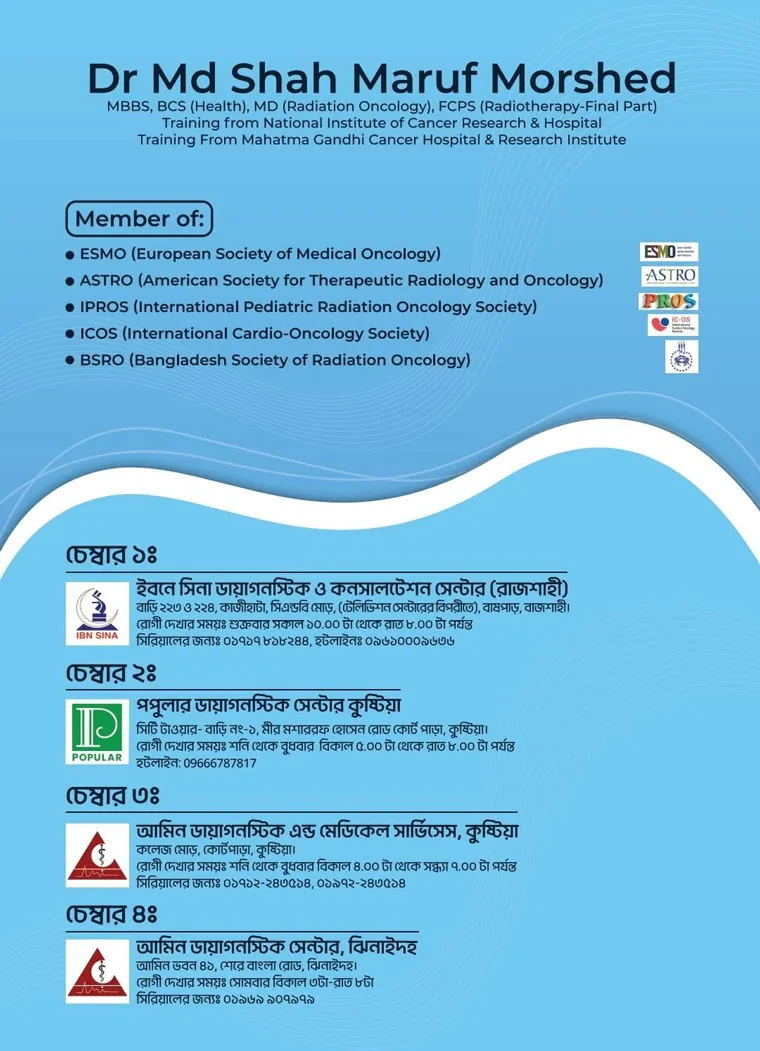
Dr. Md. Shah Maruf Morshed
Preparing for Your Visit
Arriving well prepared helps the oncologist form a clear picture during the first meeting. Carry every earlier prescription, medical report, imaging film or report, biopsy report or slide you have, and a full list of medicines you take at present. If another doctor sent you, bring the referral note or prescription so the specialist can see what has already been examined.
Note your symptoms in the order they appeared and add any history of cancer in your family, since both details guide the doctor's questions and the choice of tests. A relative or trusted companion can be useful company: they can write down what is discussed and help you recall it accurately afterwards.
Before the appointment, confirm with the selected hospital whether any preparation, such as fasting, is needed, and ask what the consultation normally involves so there are no surprises. Keep your questions in a brief written list so nothing important is forgotten in the room.
Questions Worth Asking
Begin by asking what condition the doctor suspects and which tests are needed to confirm or rule it out. Ask what each test involves, when the results are expected, and whether the tests can all be done at the same facility or must be done elsewhere.
Where a diagnosis already exists, ask which type and stage it is, what treatment options are on the table, and why the doctor favours one over the others. Useful follow-up questions cover the side effects to expect, how those side effects will be handled, how long treatment may continue, and what the follow-up schedule will look like.
Treatment decisions often come down to trade-offs, so ask the doctor to compare the likely benefit of each option against its burden — recovery time, effect on daily life, and cost considerations you need to plan for. It is also fair to ask whether a second opinion is advisable before a major step such as surgery or a long course of therapy.
Common Cancers and How They Are Diagnosed
Oncologists evaluate many types of cancer, including breast, cervical, lung, oral, and colorectal cancers, as well as lymphomas. Each type behaves in its own way, which is why identifying the exact type and stage always comes ahead of choosing treatment.
Diagnosis typically begins with the doctor's examination and the patient's account of symptoms. Depending on what is found, the doctor may request imaging — such as ultrasound, mammography, CT, or MRI — to locate the abnormality. Blood tests can add useful information, but they cannot prove cancer on their own; a biopsy, in which a small piece of tissue is taken and studied under a microscope by a pathologist, is generally the conclusive step.
After confirmation, staging investigations show how far the disease has spread, and that finding shapes the treatment plan. Ask your doctor whether the necessary diagnostic steps can be completed at the facility you are attending, since specialised pathology review or advanced imaging may require referral to a tertiary centre.
Treatment Approaches
Cancer treatment usually draws on three principal approaches, often in combination. Surgery removes the tumour when it is confined and operable. Medicines, including chemotherapy and other drug-based therapies, can address disease that has spread or shrink a tumour before or after an operation. Radiation therapy directs focused energy at cancer cells in a defined area.
The choice among these approaches depends on the cancer's type and stage and on the patient's general health. The oncologist normally walks the patient and family through the options, explains the anticipated benefits and the side effects, and works together with surgeons, radiologists, and other specialists to put the agreed plan into effect.
Confirm with the selected hospital whether the recommended treatment is available there, since some plans may require referral to a tertiary centre. Supportive and palliative care for easing symptoms can generally be arranged across many levels of the health system, alongside or after the main treatment.
Frequently Asked Questions
How do I know whether I need an oncologist?
If a warning sign such as a persistent lump, a non-healing sore, unexplained bleeding, or unintended weight loss has appeared, an oncology opinion is worth seeking. Your first doctor can examine you and decide whether a referral to an oncologist is the right next step.
What happens during the first oncology consultation?
The doctor will review your symptoms, examine you, and go through any reports or films you bring. Further tests may be ordered to confirm or rule out a diagnosis, and you will have the chance to ask questions about what those tests involve.
Is a biopsy painful, and does it spread cancer?
A biopsy usually involves only brief discomfort, which is managed with local anaesthesia in most cases. The idea that a biopsy spreads cancer is a common worry, but it is the standard, accepted method worldwide for confirming a diagnosis.
Should I seek a second opinion before starting treatment?
A second opinion is a reasonable step before a major decision such as surgery or a lengthy course of therapy, and most doctors understand the request. Bring your reports and films to the second consultation so the opinion is based on the same information.
Will cancer treatment require a long hospital stay?
That depends entirely on the treatment chosen. Some therapies are given as outpatient visits, while surgery or certain intensive treatments involve a hospital stay. Ask your doctor what the plan involves so you can arrange your time and support accordingly.
How can family members support a cancer patient?
Family members can help by attending appointments, keeping track of medicines and schedules, and noting down what the doctor advises. Emotional support matters too — listening without rushing to conclusions helps the patient face treatment with more steadiness.
Sponsor Space Available
Place your banner here to reach thousands of patients daily.
Grow Your Practice
Premium placement for hospitals & doctors.